Being Vegetarian Helps the Environment

In this post, I want to explain the vegetarian mindset. I will also try to answer why they choose vegetables over meat and what does eating meat having to do with reducing the carbon footprint.

Meat is a choice of food of humans since prehistoric times. It is being gathered by hunting down the animals such as chickens, sheep and cows. Scientists think that along with the diet with its high protein rate and essential nutrients, meat played a big role in the development of human intelligence.

But nowadays it is being controversial to eat meat because it is being claimed that meat is damaging the environment. Because of this, many people are converting into being vegetarian or vegan. Vegetarians and vegans state that humans can still satisfy their protein and nutrient needs with just eating vegetables. They claim that eating meat for its protein is very inefficient because we are taking that protein from an animal which got its protein from the plants it ate.

Image result for food carbon footprint"

With that in mind, I want to turn back into my original topic. When we look which types of food require the most carbon dioxide to become ready to be consumed, we see that meat is the most carbon dioxide requiring food. Therefore it is leaving a much bigger carbon footprint into our world than other food types. So my main point is that people should be aware that meat can and should be replaced with vegetables if they want to take care of the environment. Thank you for reading.

Carbon Footprint at Cafeteria

#week 1 / Onur ÇAKICI

At the cafeteria of Abdullah Gul University, there are two different types of food is eaten by the students and the instructors. One of them is made of meat such as chicken and the other of them is made of vegetables such as peas, potatoes. During this week which is the first week of the module 3 of Global Issues course, I’ve noticed that a huge population prefers the meal which includes meat in it instead of vegetables one and actually most of these people don’t eat them all and put their food back to the trash because of variety of reasons such as not liking it or having lunch before getting hungry. This situation is causing a huge consumption in the school base but if it is thought in the long run, the world’s wealth is consuming for nothing. Something has to be done for this problem!

Meat Free Monday

Meat Free Monday is a global campaign based on not eating meats on Mondays. It is Launched by Paul, Mary and Stella McCartney in 2009.  Eating meat-free one day a week could reduce the climate impacts of the foods. It may seem like a small step, but when it is considered lots of people do not eat on Mondays, it could be a huge movement. It is a project that started to achieve these goals. Now, the campaign held on in the UK, US, Canada, Australia, Belgium, Brazil, Taiwan, Japan, Germany, and Russia. São Paulo which is a city in Brazil (with 10 million people), has the Meatless Mondays. No matter Brazil is one of the countries that exports meat mostly in the world.

What Can I Change In a Week?

We don’t know how we contribute to CO2 emission. We are not aware of how the things we have done affect our environment and climate. So during one week, I considered my actions and I tried to lower my CO2 emission. Firstly I have tried to reduce the use of electricity at home. I wanted my family to be careful about it. So we have always unplug the electrical devices when not in use.

 Also, we turned off the lights when it is unnecessary.

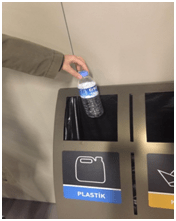
I always leave my phone on the charge during the night. But I just turned off my phone when I was sleeping during the week. I tried to use recycling bins for recyclable materials.


The photo was taken when I was throwing my plastic bottle into the recycling bin.

If everyone would be careful about the usage of electricity, we could reduce the emissions from coal-fired electricity plants. On a global level, if people would start to recycle more, we could save more energy.

Carbon Footprint Due to Food and My Observations

The problem is the carbon emissions due to foods. Food undergoes some steps like growing, rearing, farming, processing, transporting, storing, cooking and disposing of. And all of these steps are the cause of CO2 emission. The more we eat meat, the more CO2 produced. The more CO2 concentration in the air means the more danger of climate change we are in.

Here are my some observations:

At home, my mother cooks foods that contain meat or just meat at least three times a week.

When she cooks soup or rice, she adds chicken broth.

For breakfast, we may have eggs, bologna, sausage and more.

In the refectory, 2 meals are served for the main course. One of the meals always includes meat. I see people always choose a meal with meat.

It is one of the menu we had in the refectory.

My friends staying in a dormitory, when they do not like the meal provided in the dormitory, I heard that they order some foods contains food. Or sometimes they go to a mall to eat pizza, doner, ıskender, etc.

I see people eating fast food like hamburgers, pizza all the time.

If people continue to eat too much meat as I observed, we cannot be able to stop our carbon footprint. Because all steps until meat comes to our plates contributes to climate change. The problem does not finish with people around me. We should concider all people in the world. It shows how big the problem is.

What we can change in a week ?

Until these times I always used bus to go to the university but after our AguWays lesson I decided and started to ride bicycle.
I realized that I have consumed too much fast food which requires unfriendly oils for the environment and I stopped eating them.
During Black Friday even though my friends bought new clothes I didn’t buy anything and I decided to use ones which I already had.
I stay at dormitory and I always observe the energy is not saving by some irresponsible people. They always left the light open after they used it and I always close lights after them. Finally I have warned one of them and he said me that he will be aware of it from now.

2 Changes at Daily Routines

#week 1 / Onur ÇAKICI

After calculating my carbon footprint, I’ve been thinking that how I can reduce it and I find two easy things that can be changed in my daily life routine, which will reduce my carbon footprint. Firstly I’ve decided to not buy water from outside instead I bring my water in a glass bottle everyday to school.

If we think that I drink around 1-liter water in school everyday, I’ve saved at least 2 Turkish liras and reduced my plastic waste. Secondly, during the whole week at the school cafeteria, I didn’t have lunch that includes meat in it to reduce carbon footprint. These two changes in my daily life can be seen as a really small change but if everyone comprehends the purpose of under these changes and do them in their life too, they’ll save their money and have a healthy diet while reducing their carbon footprint. Would you consider to join apply them to your own routine?

“Dear Piece of Meat – We Need to Talk”

#week 1 / Onur ÇAKICI

Sweden’s supermarkets campaign to reduce meat consumption

Two of the largest supermarkets in Sweden have launched campaigns aimed at creating increased consumer awareness around the environmental impact of meat, encouraging consumers to lower their intake of meat and promoting plant-based alternatives.

The supermarket chain Coop has published a video called “Dear piece of meat – we need to talk” where they describe meat’s high climate and environmental impacts and promote reduced meat consumption. The message of the video is that they want to help create new attitudes towards vegetarian food and encourge people shift to a more plant-based every-day food.

The other supermarket chain ICA, has created a series of youtube films featuring interviews with Swedish people about their food preferences and attitudes to vegetables. Also brought a top chef to prepare vegetarian meals and portrayed the consumer’s reactions. They mention the main reasons to eat vegetarian food such as animal welfare, health, and private economy.

Source: Food Climate Research Network