I this week I want to give some interesting numerical facts about the food waste to show how serious the problem really is.
More than 1/3 of the produced food is being wasted.
Every year, 1.3 billion tonnes of food is wasted in the world. Its estimated value is $1 trillion globally.
With less than a quarter of the food wasted in US ,UK and Europe, one billion hungry people could have been fed.
A quarter of the world’s potable water and an area that is bigger than China are being used just for the wasted, non-eaten food.
The wasted food results in 4.4 gigatonnes of greenhouse gas emissions per year. If that much gas emissions were made in a country, that country would be the third biggest greenhouse gas emitter.
Throwing away a burger and taking a 90 minute shower wastes the same amount of water.
Beef production is one of the main contributor to CO2 emmision. The production processes are the treats for our environment. When we concider how big the beef concumption in the world espcially in America, we would start to think about the consequences.
Even the gas cows make, produces methane which has 21 times bigger impact on the climate change than CO2. 🙂 This is amusing but real.
The amount of burgers eaten in America in a year, produces greenhouse gas as 34 coal-fired power plants do in a year. I recommend you to video below.
And see how big the impact of the beef on our environment!!
Today, I want to point out the importance of carbon footprint especially caused by food consumption.
According to the reports, in the US, each household produces 48 tons of greenhouse gases. Transport, housing and food have the three largest carbon footprints. Food produces about 8 tons of emissions per household, or about 17% of the total. Worldwide, new reports suggest that livestock agriculture produces around a half of all man-made emissions.
Changing the foods that you eat can have a big impact on your carbon footprint. And reduce pollution, preserve the environment and slow global warming. Many of these changes will also save you money, improve your health and even keep you fit! Have a browse of How You Can Fight Climate Change for more ideas on taking action to save our beautiful planet.
Carbon Footprint Ranking of Food
The following table shows the greenhouse gas emissions produced by one kilo of each food. It includes all the emissions produced on the farm, in the factory, on the road, in the shop and in your home. It also shows how many miles you need to drive to produce that many greenhouse gases. For example, you need to drive 63 miles to produce the same emissions as eating one kilogram of beef.
Meat, cheese and eggs have the highest carbon footprint. Fruit, vegetables, beans and nuts have much lower carbon footprints. If you move towards a mainly vegetarian diet, you can have a large impact on your personal carbon footprint. You can be change your diet by looking this table and comparing which kind of foods are causing more carbon emission.
Rank
Food
CO2 Kilos Equivalent
Car Miles Equivalent
1
Lamb
39.2
91
2
Beef
27.0
63
3
Cheese
13.5
31
4
Pork
12.1
28
5
Turkey
10.9
25
6
Chicken
6.9
16
7
Tuna
6.1
14
8
Eggs
4.8
11
9
Potatoes
2.9
7
10
Rice
2.7
6
11
Nuts
2.3
5
12
Beans/tofu
2.0
4.5
13
Vegetables
2.0
4.5
14
Milk
1.9
4
15
Fruit
1.1
2.5
16
Lentils
0.9
2
Figures from the Environmental Working Group’s Meat Eater’s Guide and the EPA’s Guide to Passenger Vehicle Emissions.
In this week’s post I will give some helpful recommendations to decrease the food waste.
Think carefully while you are shopping for food. Before you buy any amount of food, you should first have a plan about how much of it you will eat or use in something. You should never buy more than needed.
Find your ideal portion. You should find your ideal portion by taking care of your diet. That way you will be able to maintain a healthier life while taking care of the environment.
Think of ways to use the leftovers. The fact is most of the leftovers can be used in the preparation of another food. For example you can crush the leftover breads to use it inside of meatballs.
Store your food carefully. It is certain that so much food is wasted just because they are not stored responsibly. Find the best way to store your each type of food.
Our BAT topic was about the ecological footprint caused by our eating habits. For our first presentation in the class, we have researched about it a little bit. The problem is the greenhouse gas emissions from not just cooking the food but from its production process. We searched in the web to find what types of food is causing the most carbon emission and found out that the meats such as beef and lamb and dairy products require the most carbon gas to be produced. So with that in mind I analysed what we are eating for a while and I think we are not that bad in what we choose to eat. We are mostly eating carbohydrates such as pasta and bread with seasonal fruits and vegetables. Our worst habit is that we sometimes order food and when we do order, we are mostly eating meat based foods such as chicken wrap. Also we are using dairy products such as eggs or butter in the preparation of our meals. In the weekdays we are eating our lunch at school. In school there is always -along with the vegetables and a meatless meal- a meal with meat in it.
On the issue of responsible consumption, there is one topic that particularly peaks my interest- plastics. We all know how the wrong disposal of plastic can pollute the oceans- whatever doesn’t wash back up on shore poses a threat to all marine life. Land disposal as well; shipping of trash to other countries, improper recycling or no recycling at all, and so on.
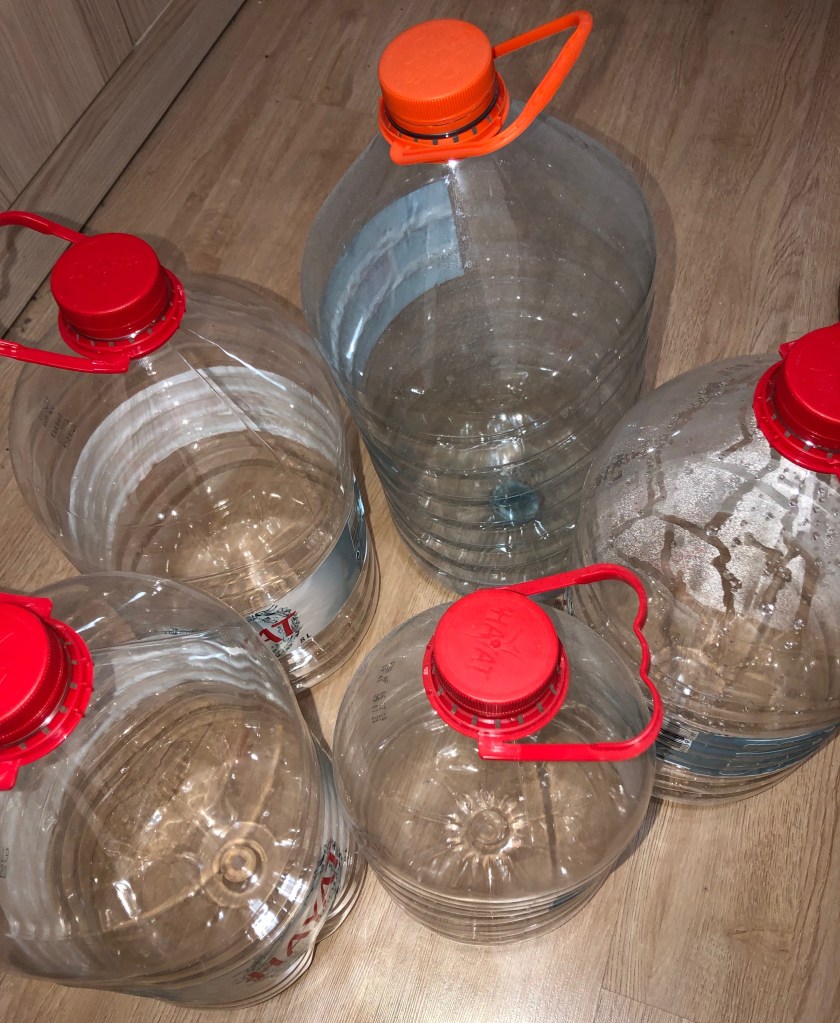
Plastic water bottles Photo Credit: Author
Although i have two large shopping bags that i have so i don’t have to buy plastic bags, there was still a lot i could do to reduce my own plastic footprint. It was only recently when cleaning out my room that i realized how much plastic I’d been consuming from buying 1.5, 5, and 8 Litre bottles. It was a lot, most of which probably won’t be properly recycled even if i throw them away properly. If i hadn’t been stacking them up, i wouldn’t have actually understood how much plastic only i have consumed in just a month. And considering how many other people are buying just as much or even more bottles of water, well… let’s just say an incredibly high amount of plastic.
I had to do something. For one, I’m planning on working with my friend in Architecture in turning some empty bottles i have into mini trash bins around the house. And for the solution for a new source of drinking water, i found out that there are water companies that deliver 19 Liter water bottles (damacana) right to our doorsteps. Although these bottles are plastic, we never really throw them away because the company just takes the empty bottles and replaces them with new full ones. The empty ones, I’m guessing, is then cleaned in the factories and refilled with water. That’s a lot of plastic saved, and i made some calculations showing that I’m actually saving money too. A win for me, and a win for the environment.
I will as well put my friends who buy a lot of water bottles on this too as i think that it’s a great idea to make a huge difference with small changes.
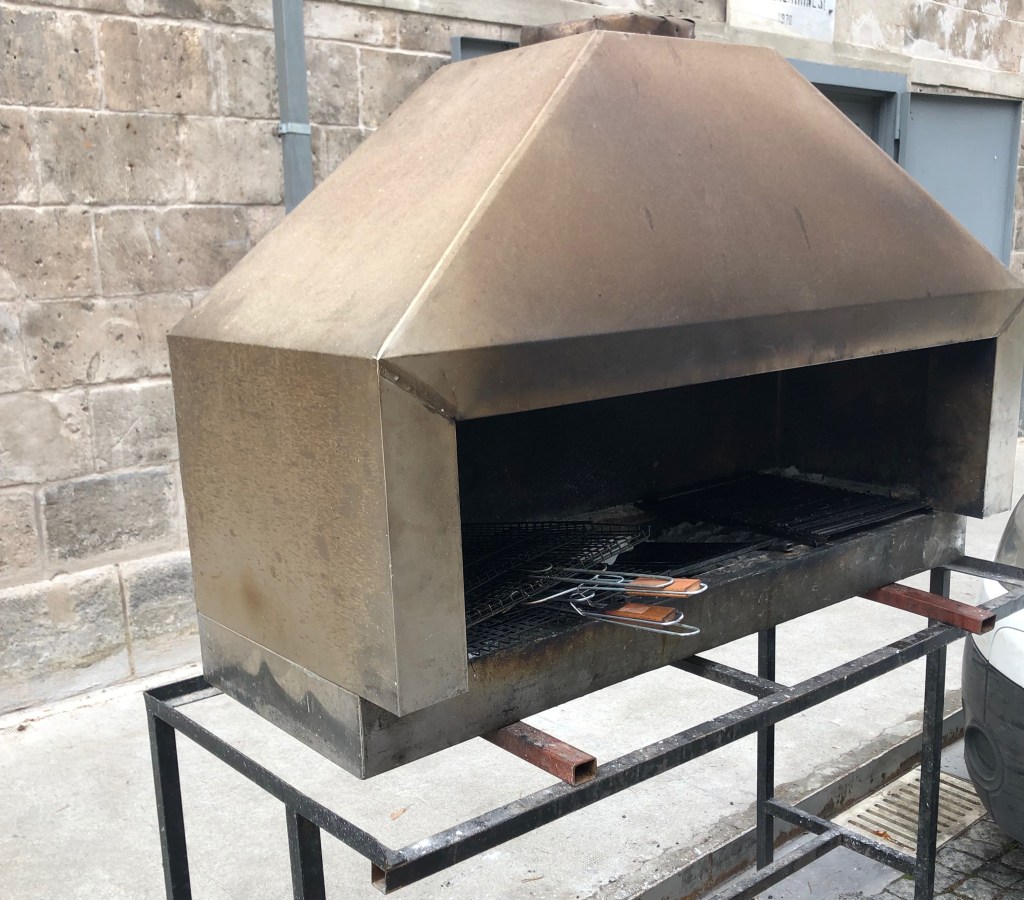
Our unversity offers a certain dish once in a while for lunch in the cafeteria- Mangal or grilled food (usually chicken). Although traditionally all around the world, grilled chicken is cooked on an actual grill with charcoal, this actually raises the percentage of the carbon dioxide constituent of the atmosphere. The burning of charcoal creates a reaction with oxygen that releases carbon monoxide, carbon dioxide, other gases and water. The initial production of charcoal actually involves the continuous burning of wood (cut from trees that absorb carbon dioxide and release oxygen) for days which releases several gases. One of which is methane which is a greenhouse gas just like carbon dioxide. Cooking of food on a grill essentially gives the food a ‘smokey’ flavour, but all that smoke isn’t just going into the taste but the air around us. The main consequence of that cooking method is amount of carbon dioxide and other harmful gases released into the atmosphere, raising the carbon footprint of the university itself and everyone paying for the meal. I believe that the university can reduce its carbon emissions to an extent by either looking for alternative ways to cook certain dish or changing its menu a little to not include food whose preparation process poses a threat to our environment.
In 2017, Australia was the world’s third largest exporter of red meat. This makes the red meat sector an important part of the country’s economy- contributing around $18.4 billion in GDP in 2016-2017, according to Meat and Livestock Australia. However, with all that meat production comes greenhouse gas emissions. In a move to greatly reduce the carbon emissions of the production of red meat, the Australian government is working with Commonwealth Scientific and Industrial Research Organization (CSIRO) to first identify and establish the causes or sources of greenhouse gas emissions, and then invest in a research aimed at developing new ways to reduce these emissions as well as increasing productivity gains in the red meat sector. This project is of great significance as the red meat sector is responsible for as much as 13% of Australia’s total emissions (Commonwealth of Australia 2017). Australia’s move in the red meat sector isn’t just to reduce emissions but to become completely carbon neutral by 2030 (the first country to do so) through advancements in this research project. This project is both beneficial to the environment and Australia’s government, and with progress, other governments would soon follow suit in a global reduction and soon elimination of carbon emissions of red meat production.
Within a week I can be more careful about my electrical devices such as my laptop. With that I will be able to save money and environment at the same time!
We are sometimes leaving the lights on while we are not studying so I can turn off the lights when I don’t need them. Doing this will also reduce the light pollution. Therefore, it will be helpful for the light sensitive creatures.
We are now in winter so we turn up the heat from our combi but the weather is not always that cold so we (me and my housemates) can reduce the usage of the natural gas too.
Also I can be more careful about what I eat. From what I have seen from the web, among the other types of food, in production, the most carbon dioxide requiring food is meat. So from now on, I will think twice before I eat meat again.
Our topic was the effects of food consumption to the footprints. Food consumption is amongst the main drivers of environmental impacts. Food processing and logistics are the next most important phases in terms of environmental impacts, due to their energy intensity and the related emissions to the atmosphere that occur through the production of heat, steam and electricity and during transport.
I recently observed that we ate too much chicken and meat in the dining hall. We are not aware of what is healthy and light for our body. The impacts of these kind of foods are very clear and visible.




 FOOD CONSUMPTION