#week 3 / Onur ÇAKICI
Today I want to share the information about how we can decrease our carbon footprint by explaining in 4 different tips.
Eat vegetarian
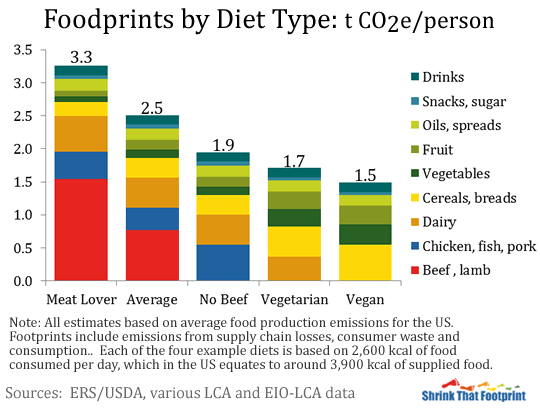
Livestock farming produces from 20% to 50% of all man-made greenhouse gas emissions.
Shrink That Footprint’s chart shows that a meat lover has the highest carbon footprint at 3.3 tons of greenhouse gas emissions. A vegan diet has the lowest carbon footprint at just 1.5 tons CO2e (Carbon Dioxide Equivalent). You can reduce your foodprint by a quarter just by cutting down on red meats such as beef and lamb.
The carbon footprint of a vegetarian diet is about half that of a meat-lover’s diet.
It’s good for the animals too! Most animals are raised in factory farms where they live in horrific conditions. The factory workers also suffer from poor wages and dangerous working practices. Factory farms are heavy polluters of the air and ground. The meat they produce is also polluted with superbugs. Over 3.5 million people get sick from eating ‘dirty’ meat every year in the US.
It’s good for you too! Vegetarians live longer than meat-eaters. Vegetarians are slimmer than meat-eaters. Vegetarians have a lower risk of getting heart disease, high blood pressure, diabetes and cancer.
- use proteins such as beans, lentils, tofu, tempeh and quorn to replace meat, cheese and eggs
- make sure you are getting enough iron and zinc by including lots of wholegrains, beans and a variety of vegetables
- invest in some vegetarian or vegan cookery books and have fun experimenting
- don’t rely on vegetarian processed foods.
Bring back home-cooking
Take control of the food you eat and base your meals on natural foods such as vegetables, fruits, whole-grains, beans and lentils with a little meat and fish:
- discover the simple pleasures of preparing and eating your own meals
- check out Vegetarian Recipes for lots of tasty ideas
- improve the health of you and your family – see more at Vegetarian Nutrition
- plan your meals ahead to reduce wastage
- save your leftovers and create a new meal with them
- if you can, make your own compost with uncooked vegetable scraps.
Cooking smartly
Did you know that a gas oven only uses 6% of its energy to cook? And an electric oven is not much better at 12%. If you use the oven on a warm day, you will also heat up the room and need to turn on a fan or air-conditioning. In fact, the most efficient cooking method is simmering on the stove-top.
- eat more raw foods that do not need cooking
- use the stove-top whenever possible
- next best is the microwave as it uses 50% less energy than an oven
- use the oven sparingly and smartly…reduce preheating, cook multiple foods, turn off early
- use electric kettles to boil water for cooking or drinking.
Eat Organic
Organic farming methods for both crops and animals have a much lower impact on the environment than conventional methods. Organic-certified farms must use natural methods for soil fertilisation, weed prevention and pest control. Antibiotics and growth hormones cannot be used to raise food animals, and there are standards of care which prevent cruelty to livestock. Genetically-modified and irradiated foods cannot be labelled organic and its better to avoid these processes which are not proven to be safe for us or the food chain.
Organic food is better for you too! Crops are grown in fertile soils that are full of nutrients – and these end up in your food and then in you. Livestock are able to roam the fields and eat their natural food – grass – rather than being force-fed corn. And this leads to a much less fatty meat that keeps your heart healthier.
In the next week, I will give you more tips to reduce our carbon footprint. Looking forward to see you next sunday.
Resource: http://www.greeneatz.com/
 FOOD CONSUMPTION